Touch Analysis
reports the musical analysis, which bells perform all of the work
and the calling positions transposed for each bell.
Musical Analysis
looks for named rows
(eg. Queens, Kings, Tittums), Near Misses and Combination Near Misses.
It also looks for roll ups and combined roll ups (CRUs)
including all parts of rounds, reverse rounds, odds and evens (parts of queens) +reversed,
major and minor chords,
and alternates (eg. 5.6.7.8, 8.7.6.5) within each change and across hand+back strokes.
This includes unlimited touch lengths (including an extent of Major)
and more musical sequences, transposed, and extended on higher numbers.
Over 130 musical sequences can be found on 8 bells (over 600 on 16), although
which rows are musical is, of course, personal, and you get different music (and results) with the tenor behind.
Analysis Options
lets you select 2, 3 or 4 bell sequences off back/front, 3 or 4 bell sequences in the middle or across hand+back,
3 or 4 bell alternates, Minor chords and Named Rows or the respective bell sequences.
It also lets you switch the Calling Positions Basis, and immediately updates the display
All the work:
shows which bells do all the work of working bells, all the work of plain leads (incl. unaffected),
all the affected work at calls, and also which are unaffected.
These can be useful, either for the technically minded peal ringers,
or to help a learner on practice night.
This includes multi-method touches, where all the work at plain leads is significant.
Calling Positions:
Each of the working bells is listed, with the positions when each call is made, transposed for each bell.
While calling positions are usually applied to the tenor,
this can help you to identify touches which can be called easily from another bell.
The Copy Call Pos' button allows you to copy a set,
for any of the bells, directly to the calling positions editor.
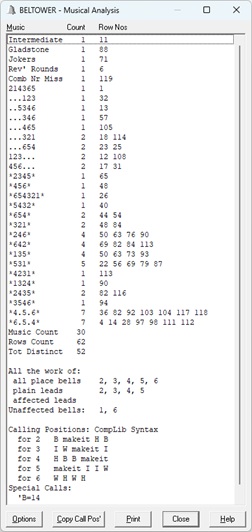
Screen Shot 1:
This example is a standard 120 of Plain Bob Minor, Wrong and Home repeated, from the tenor.
The stars indicate that the roll-up might be found in distinct rows or across hand-back strokes.
You can select whether to show and count roll-ups shorter than 3 or 4 bells.
All working bells are shown to do all the work, as they each start at least one lead in each place.
None of the bells do all the work of affected bells, at the calls
ie. Run In, Run Out and Make The Bob at succesive Bob calls.
The 6 is unaffected at all of the calls.
The calling positions are given and the Basis (CompLib Syntax) selectable in Analysis Options.
The position names are editable in the Calls Editor, so you could change 'makeit' to M (normally Middle),
4, 4ths, F, IV or anything else, if you like.
Special Calls (BSEFTUVWXYZ) are also shown where applicable.
This Bob illustrates a special call over-ride, despite being the normal 4th place Bob.
|
|
 |
Method, Touch and Peal Prover
The prover checks methods and touches, including spliced, of unlimited length, so an extent of Major is no problem.
The prover has a fast-check mode for most methods, and
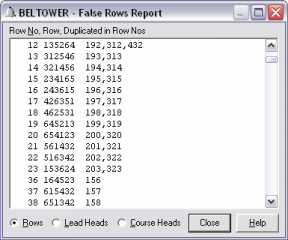
the false rows, false lead heads and false course heads reports give details of duplications.
The False Rows report Screen Shot 2: shows details of duplications.
|
|
 |
 BELTOWER